

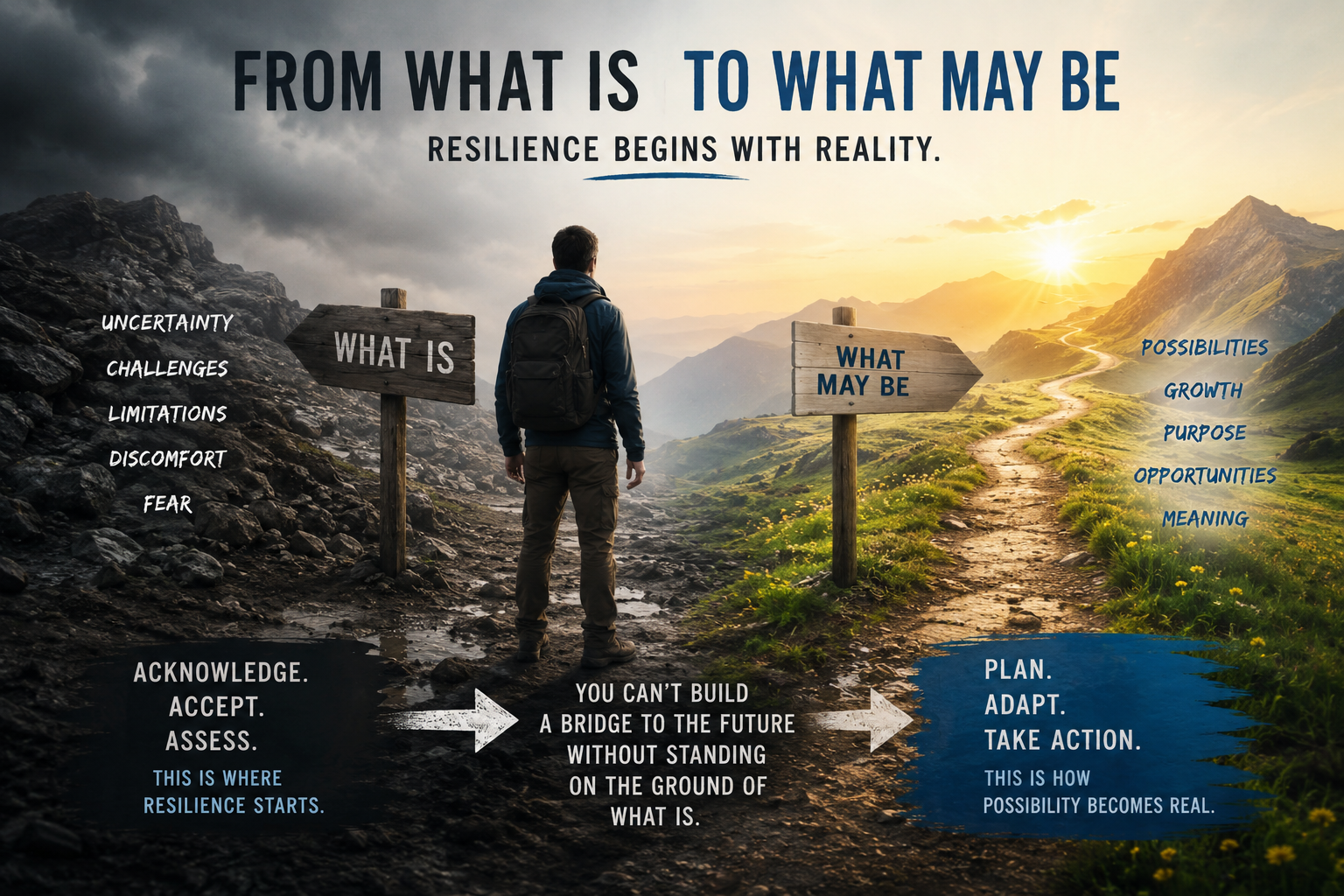
One of the greatest barriers to resilience is not adversity itself. It is our tendency to skip over reality and jump directly to fantasy.
When faced with a difficult situation, many people immediately focus on what they hope will happen, what they wish were true, or what they imagine the future could become. While optimism has its place, resilience does not begin with hope. It begins with reality. The bridge between where we are and where we want to go can only be built after we honestly assess the ground beneath our feet. Trying to reach “what may be” without first acknowledging “what is” is like drawing a destination on a map while refusing to look at your current location.
The Reality-Based Resilience Project was created to explore a simple but powerful principle: adaptation starts with accurate perception. Whether we are dealing with health challenges, financial setbacks, organizational change, injury recovery, relationship difficulties, or major life transitions, the first step is accepting the facts as they exist today. Acceptance is not approval. It is not surrender. It is simply a willingness to see reality clearly. Research on resilience consistently shows that resilient individuals confront the realities of their situation while maintaining confidence in their ability to adapt and move forward. They do not waste energy arguing with reality; they use that energy to respond to it.
Once we fully acknowledge what is, we can begin the work of creating what may be. This is where resilience becomes practical. We identify what can be changed, what cannot be changed, and what actions are available right now. The future is not created through wishful thinking or denial. It is created through repeated adaptations to present circumstances. Every meaningful transformation begins with a truthful inventory of reality. The paradox is that accepting reality often creates more freedom, more options, and more opportunity for change than resisting it ever could. Acceptance provides clarity; clarity enables action; and action creates possibility.
At Adapt Research Projects, we study resilience not as the ability to avoid reality, but as the ability to engage with it. We believe the path to a better future always runs through the present moment. Before we can reach what may be, we must first understand—and work with—what is.